Updated October 2026 · About a 6-minute read
Short answer: choose a jump starter rated for a slightly bigger engine than yours (especially if you drive a diesel), with proper safety protection on the clamps, and from a local seller who offers a real warranty. If it also has a built-in tyre compressor, you're covered for the two most common roadside problems in one device.
What is a portable jump starter?
A jump starter is a compact lithium battery pack with its own set of clamps. Instead of finding another car and using jumper cables, you clip it onto your battery and start the car yourself. Most fit in a cubby or under a seat, and many double as a power bank for your phone.
Jump starter vs jumper cables
- Jumper cables are cheap, but you need a second car, someone willing to help, and both cars parked nose to nose.
- A jump starter works alone, anywhere: a parking basement, a quiet road at night, or your own driveway. That independence is the main reason people buy one.
1. Match it to your engine size
This is the most important spec. Bigger engines, and especially diesel engines, need much more power to turn over than small petrol engines. Manufacturers usually state the engine sizes a unit can start, for example "petrol up to 6.0L, diesel up to 3.5L".
- Small hatchbacks and sedans (1.0–2.0L petrol): almost any decent jump starter will do.
- SUVs, bakkies and diesels (2.4–3.0L diesel, like most Hilux, Ranger and Fortuner models): check the diesel rating specifically, and choose one rated for a bigger engine than yours. For example, a 2.8L diesel bakkie needs a unit rated for diesel up to at least 3.0L, and preferably 3.5L.
- In winter, cold engines and tired batteries need more power, so a little extra capacity is worth it.
A note on "peak amps"
Boxes often show a big number like 1500A peak. Peak amps is a short burst figure and isn't measured the same way by every brand, so don't compare units on that number alone. The stated engine sizes are a more useful guide to what it can actually start.
2. Safety features are not optional
Connecting clamps to a battery the wrong way round can cause sparks or damage. A good jump starter has a "smart" clamp box with protection built in. Look for:
- Reverse-polarity protection warns you and won't send power if red and black are swapped.
- Anti-spark design, so clipping on doesn't spark.
- Short-circuit and overheat protection.
- Over-charge and over-discharge protection for the internal battery.
- A boost button for batteries that are so flat the unit can't detect them.
3. Battery capacity and keeping it charged
Capacity (shown in mAh or Wh) decides how many jump starts and phone charges you get from one charge. A 12000mAh unit typically handles many starts on a full charge. More important than the exact number:
- Charge it every few months, even if you haven't used it. A flat jump starter can't help you.
- Look for USB-C charging, so you can top it up from a phone charger or in the car.
- A battery level display tells you at a glance whether it's ready.
4. Useful extras: tyre compressor, power bank and torch
The best value in South Africa is a multi-purpose unit, because breakdowns rarely come one at a time:
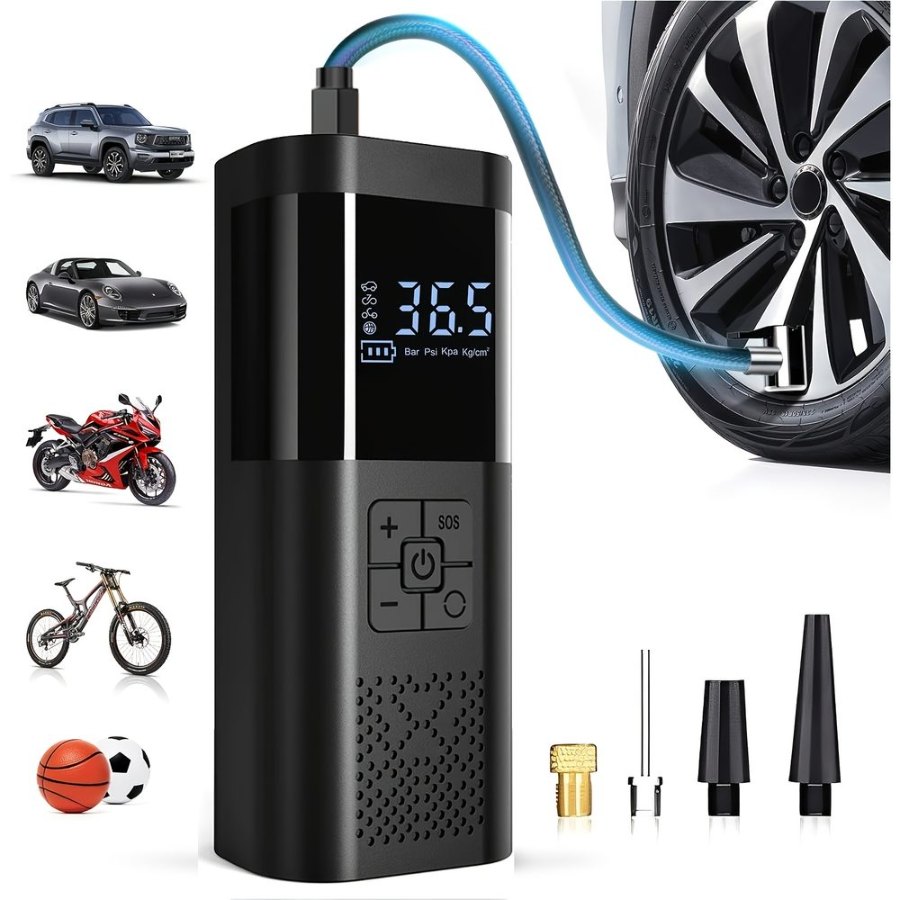
- Built-in tyre air compressor: pump a soft or slow-leaking tyre to the right pressure. Models with a digital gauge and auto stop are the easiest: set the pressure, press start, done. It also handles bicycle tyres and balls.
- Power bank: charge your phone when you're stuck and need to call for help.
- LED torch with SOS mode: essential for night-time breakdowns and handy during load shedding.
5. Warranty and where you buy it
Cheap imported jump starters can work, but the lithium battery inside is the part that matters most, and it's the hardest to judge from a photo. Buying a known brand from a local supplier with a proper warranty means you have someone to go back to if it fails when you need it most. Check how long the warranty is and who honours it.
How to jump-start your car safely
- Switch the car off and make sure the jump starter is charged (most need at least half charge).
- Plug the smart clamp box into the jump starter.
- Connect the red clamp to positive (+) and the black clamp to negative (−) on the battery. Make sure the terminals are clean.
- Wait for the "ready" light (often green). If the battery is very flat, press Boost.
- Start the car. If it doesn't start, wait a couple of minutes before trying again, and don't try more than about three times in a row.
- Once the engine runs, remove the clamps straight away and leave the engine running for a while so the alternator can recharge the battery.
Always follow the instructions that come with your specific unit. Jump starters are for 12V vehicles only.
Tyre pressure tips while you're at it
- Your car's correct tyre pressure is usually on a sticker inside the driver's door or the fuel flap, often around 2.0–2.5 bar for cars.
- Check pressure when tyres are cold, before a long drive.
- A compressor gets a slow-leaking tyre to the next tyre shop. It doesn't fix a puncture.
Our recommendation
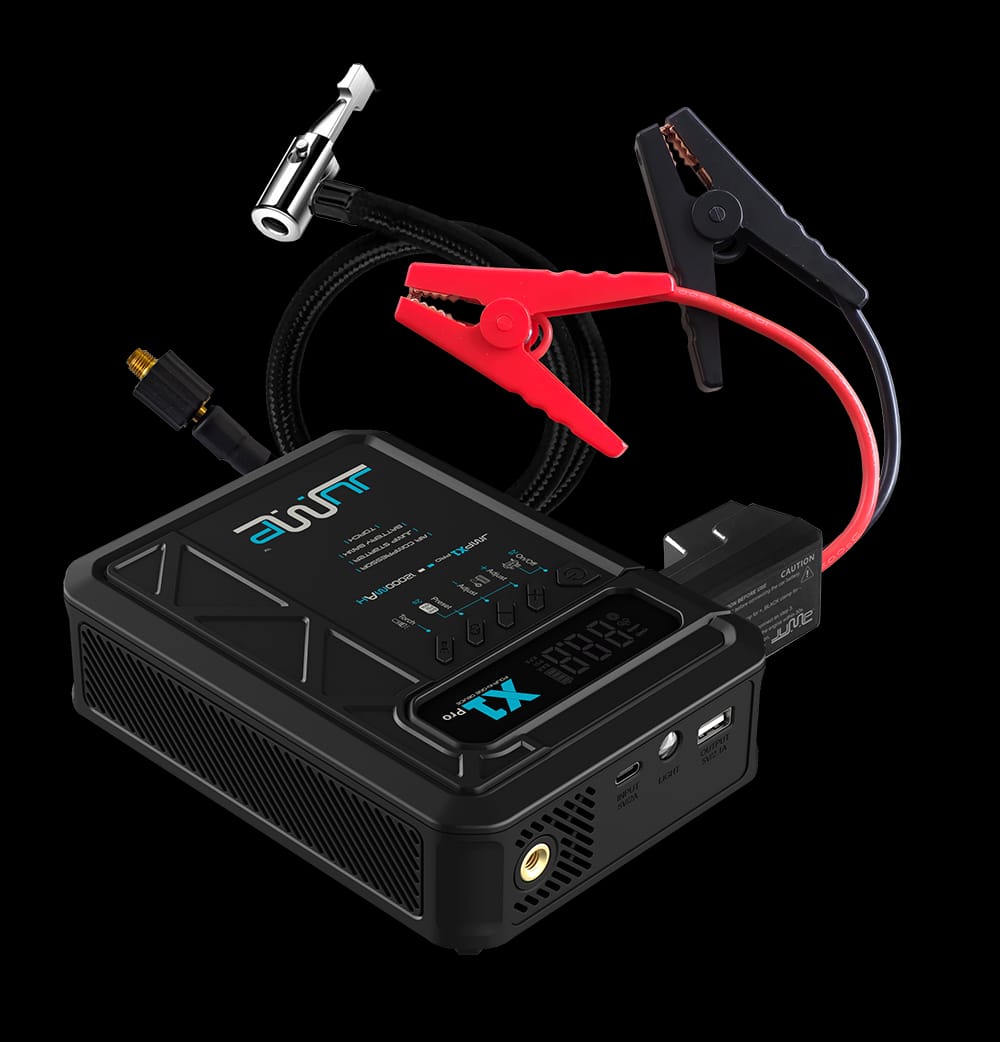
If you want one device that covers flat batteries and low tyres, the JUMP X1 Pro is the one we stock and use. It's a 4-in-1 jump starter, cordless tyre air compressor (up to 150 PSI with auto stop), power bank and torch. It starts petrol engines up to 6.0L and diesel up to 3.5L, has a smart clamp with reverse-polarity, anti-spark and overheat protection, and comes from a local supplier with a 2-year warranty.
Only need to pump tyres? Our cordless tyre inflator is a smaller, cheaper option for the cubby.